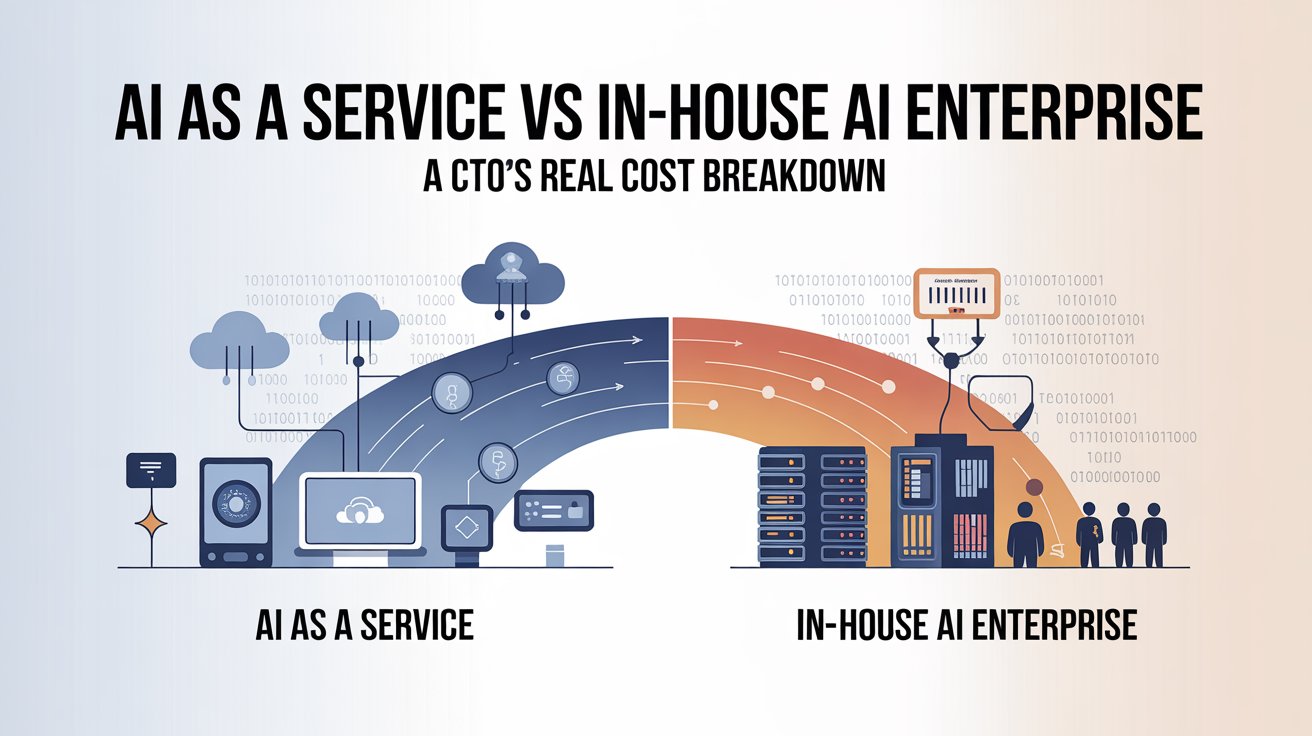
AI-as-a-Service vs. Building In-House AI: Which Actually Makes Sense for Your Enterprise?
Fourteen months. That's how long it took one enterprise team I know to build an internal AI system that, I'll be blunt, an AI as a service platform could have had running in maybe five or six weeks. Smart team. Decent budget. Real commitment from leadership. And they still came out the other side with something that barely cleared the bar of what they actually needed.
That's not a failure story about bad engineers. It's a story about a decision that looked right on a whiteboard and fell apart in practice.
The build-vs-buy question for enterprise AI comes up constantly right now, and the reason it's hard isn't technical. There's a lot of identity wrapped up in the build option. "We're building our own AI" sounds serious. Sounds strategic. Sounds like you know what you're doing. And sometimes it genuinely is the right call. But more often than not, especially for mid-to-large enterprises that aren't literally selling AI as a product, it isn't.
Let me walk through why.
The In-House Cost Conversation Nobody Wants to Have
Here's how the internal pitch usually goes: "We already have the engineers. The marginal cost is lower than you think."
It's rarely true.
A senior ML engineer, someone who can actually own model development end-to-end and not just run pre-built pipelines, runs somewhere around $180K to $260K in total comp. That's before the recruiter fee, which for specialized AI talent tends to land in the 20–25% range. And you need more than one. You need data engineers who can build and maintain pipelines. You need an MLOps person. Someone to own compliance and security, because in a regulated industry that's a full-time job on its own. Maybe a researcher if you want anything genuinely custom.
Before a single model is trained, you're probably burning through a million dollars a year in salaries. Often more.
Add GPU compute. Not cheap, and not a one-time cost. Add storage, monitoring, and the tooling stack to keep a production system from drifting and quietly failing on you. Add the fact that AI systems don't stay working on their own. Models drift. Data distributions shift. What performed well in Q1 can quietly degrade by Q3 if nobody is actively watching it.
And then add time. Twelve to eighteen months to production is the optimistic number for an in-house enterprise AI build. That assumes you hire well on the first try, no major scope changes, and no key engineer leaving mid-project. I've watched timelines stretch to twenty-four months when things don't go cleanly.
During all of that, your competitors who went the AI as a service route are already shipping.
So Why Does the Build Option Keep Winning Boardroom Votes?
A couple of reasons.
Control is the obvious one. Owning the infrastructure, the weights, the roadmap. No vendor changing pricing on you. Your uptime isn't tied to someone else's. And you're not stuck waiting for features on a vendor roadmap that you needed last quarter.
And sometimes the compliance concerns are real. Healthcare, finance, defense: data handling obligations are serious, and the cost of getting it wrong is severe. Those concerns deserve to be taken seriously.
But here's what's changed. The AI as a service market has grown up. Two or three years ago, "enterprise-grade AIaaS" was kind of an optimistic label.
Now? Private cloud deployment, on-premise options, data residency controls, zero data retention guarantees, HIPAA-compliant infrastructure. These aren't niche add-ons from specialized vendors anymore. They're standard.
The "we have to build in-house for security reasons" argument used to be a lot harder to push back on. It's not that it's wrong now. It's that it requires a lot more specificity to hold up.
The 5 Things That Should Actually Drive the Decision
When I try to cut through the noise for any specific enterprise, five criteria end up mattering more than everything else combined.
1. Data Sensitivity
This is where we always start, and not because it's the most common dealbreaker. It's the one that bites hardest when you get it wrong.
If your organization handles PHI, financial records, or anything with serious regulatory weight, the question you need to answer before anything else is simple: where does the data go when you query the model, and what are you contractually guaranteed about it?
A vendor worth working with can answer that clearly and put it in writing. One that can't, that's your answer right there. And critically, this is a vendor selection problem, not an inherent problem with AI as a service.
2. Speed-to-Market
Speed-to-market is usually where the decision gets made for most teams, honestly. If you need AI-dependent features in front of customers within the next two quarters, the in-house path is basically off the table before the conversation even starts. There's no way to compress twelve to eighteen months of infrastructure work into six.
AI as a service platforms, especially ones with pre-built enterprise capabilities, can get you to production in weeks. That's not a small gap. That's an entire product cycle.
3. AI Maturity
This is the criterion people are least honest about. A data team of three analysts who mostly do reporting isn't going to become an MLOps organization because leadership approved three new hires.
Genuine internal AI capability takes years to build. Not just in headcount, but in institutional knowledge, tooling, and process. For most organizations, that journey is still underway. AIaaS fills that gap. It lets teams operate above their current maturity level while internal capability develops in the background.
Counterpoint: if you have a large, senior ML function, truly proprietary training data, and your product differentiation literally lives inside the model, building in-house might be the only path to real differentiation. But that's a narrow slice of enterprises.
4. Total Cost of Ownership
The TCO over thirty-six months almost always surprises people who run the numbers for the first time.
On paper, "we already pay engineers" sounds cheaper than "we pay a vendor license." In practice, once you fold in recruiting costs, attrition, the tooling and infrastructure stack, and (this one's easy to miss) the opportunity cost of what those engineers aren't doing while they're building AI plumbing, the math shifts significantly.
AIaaS frequently wins the TCO comparison for mid-market enterprises. Not always. But frequently. The opex-vs-capex angle matters too. Predictable subscription costs are a much easier budget conversation than open-ended headcount growth tied to a long-horizon ROI.
5. Scalability
This one's underrated. AI workloads aren't smooth. A system handling ten thousand API calls a day might need to handle ten million within a year. Or suddenly next quarter, if a product takes off.
Architecting in-house infrastructure that can scale for that kind of variability, without chronically over-provisioning and bleeding budget, is genuinely hard. Most enterprise AIaaS platforms handle elastic scaling as a built-in feature. Your team doesn't have to design for it.
A Decision Matrix Worth Running Internally
We at IntelliSource Technologies put this together for teams who want a quick way to sense-check where they land. Score each row 1–5 based on your actual situation. Not the ideal state, the real one.
| Criterion | Favors In-House (Score 1–2) | Favors AIaaS (Score 4–5) |
|---|---|---|
| Data Sensitivity | Hard on-prem requirements, no vendor meets compliance | Vendor offers private/hybrid deployment, compliance confirmed |
| Speed-to-Market | 12+ month runway, no near-term AI product commitments | AI features needed within 1–2 quarters |
| AI Maturity | Large senior ML team plus proprietary data at scale | Small or growing data function, limited ML infrastructure |
| Budget / TCO | $2M+ AI budget, comfortable with 18-month ROI window | Prefer opex model, need faster return, budget constrained |
| Scalability | Stable, predictable, low-variance AI workloads | Variable demand, rapid growth, or unpredictable usage |
If you land between 5 and 12, in-house AI might genuinely be the right call, assuming you have the team and the runway to execute. Between 13 and 20, AI as a service is probably the smarter path. The economics and the timeline both point that way. Above 20, honestly, it's not close.
Most mid-to-large enterprises that aren't in the business of selling AI as a product land somewhere in the 15–22 range. That isn't a coincidence.
Where IntelliSource Technologies Comes In
The IntelliSourceTech AI as a service platform was built for enterprise teams who want real AI capabilities without owning the operational burden that comes with building and running them internally.
That means serious security. Deployment flexibility, including private cloud for regulated industries. And the infrastructure, updates, and compliance overhead stay on the vendor side, so your team's energy stays on the work that actually differentiates your business.
The honest version of the pitch: if your decision matrix score falls in the AIaaS range and you're still leaning toward building in-house, the real cost of that call is time and opportunity. Both are finite.
If you ran through the matrix and landed in the AIaaS column, or you're still genuinely on the fence, the conversation is worth having before the next planning cycle locks in a direction.
Contact IntelliSource Technologies today, and let's look at what an AI deployment could actually look like for your enterprise, on your timeline, within your constraints.
 Previous blog