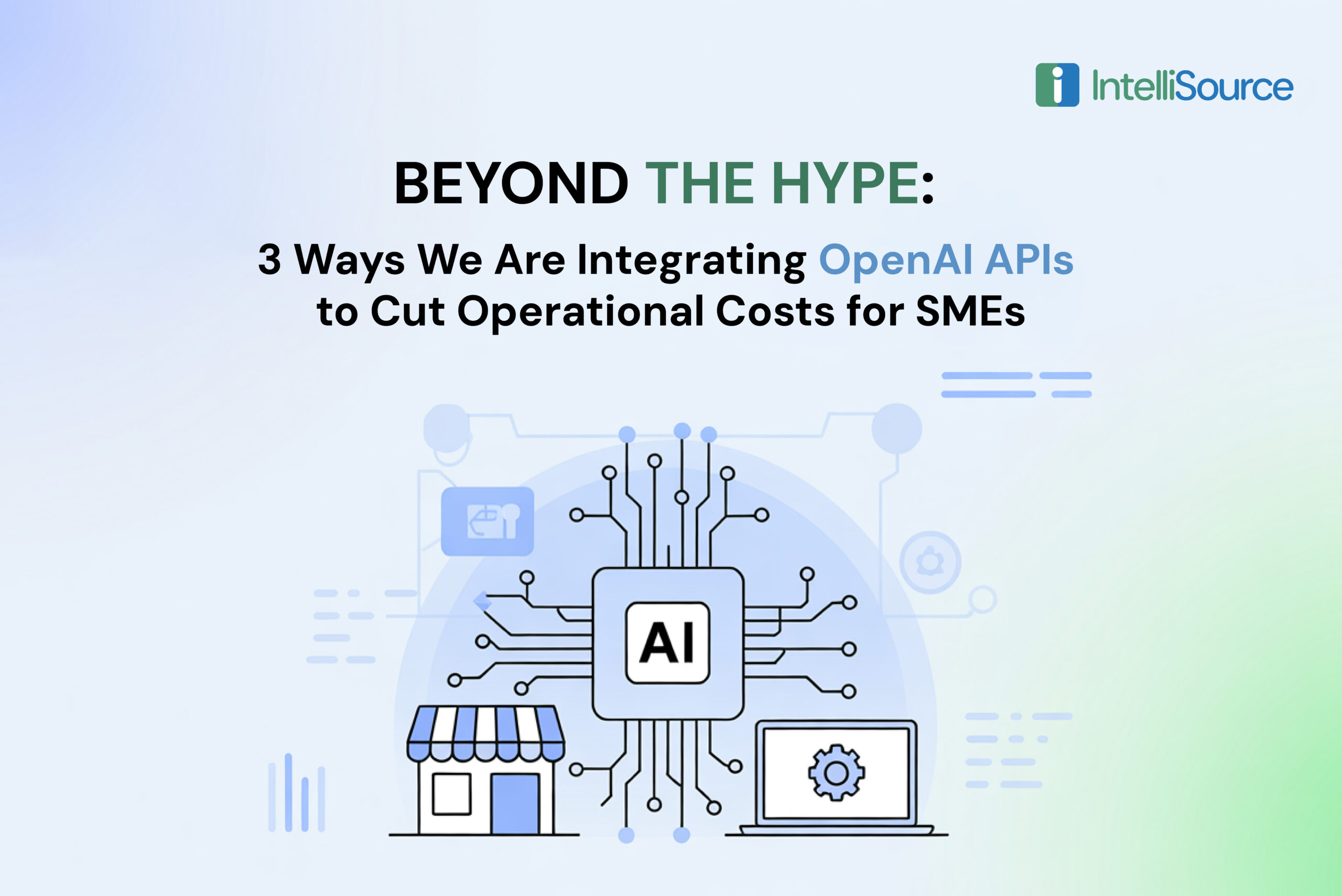
Beyond the Hype: 3 Ways We Are Integrating OpenAI APIs to Cut Operational Costs for SMEs
In 2024 and 2025, almost every business we spoke to had “tried” AI. Someone had used ChatGPT. Some had generated content. Someone had asked it to summarize a document during a meeting. It felt new, slightly exciting, and also… confusing.
By 2026, the conversation has changed.
The companies getting real value from AI today are not talking about prompts or experiments anymore. They are talking about time saved. Headcount pressure reduced. Fewer manual errors. Faster decisions. In short, outcomes.
At IntelliSource Technologies, many SME founders come to us with the same concern. They know AI can help, but they don’t know where to apply it without burning money or disrupting operations. They are stuck between curiosity and caution.
This hesitation is understandable. The AI ecosystem is loud. Everyone is selling intelligence. Very few people are talking about boring processes—the ones quietly draining operational budgets.
Here’s the simple truth we’ve learned from real deployments: you don’t need to build your own AI system. You don’t need to chase the newest model. In most cases, you just need to connect proven AI APIs to the data you already have and automate work your teams never wanted to do in the first place.
That is where AI for business process automation becomes practical instead of theoretical.
The “Boring AI” Strategy (Why It Wins)
There’s a misconception that AI must be visible to be valuable.
In reality, the most profitable AI systems rarely face customers. They sit behind the scenes. Read documents. They move data. Answer internal questions. They do it consistently, without fatigue or mistakes.
This is the approach we take at IntelliSource Technologies. We focus on operational AI, not experimental AI. The goal is straightforward: reduce operational costs with AI by removing repetitive, manual work that teams have normalized over the years.
When AI is applied this way, adoption is faster, and resistance is lower. No one argues about replacing creativity. Everyone agrees that copying numbers from PDFs should not be a human job.
Use Case 1: The “Smart Document” Parser
If you sit with a finance or logistics team for even one afternoon, you’ll see the same pattern. PDFs everywhere. Invoices, shipping documents, handwritten forms, and scanned bills.
Someone opens them. Some type. Someone double-checks. And still, errors happen.
We’ve seen teams spend 15 to 20 hours a week just transferring data from documents into systems they already own.
What we do differently
Instead of building complex platforms, we implement focused document-parsing modules using OpenAI’s Vision capabilities. These systems read PDFs or scanned documents, identify required fields, and convert them into structured formats like JSON, ready for ERP or accounting software.
No flashy interface. Just reliable automation.
What changes in practice
Processing happens continuously. Accuracy improves. Manual effort drops sharply.
In one case, a logistics company in Pune was able to automatically process hundreds of bills of lading every day. The result wasn’t just cost savings—it reduced daily operational stress for the team.
Use Case 2: The “Internal Knowledge” Chatbot
HR teams are stretched thin, but not always by complex issues.
A surprising amount of their time goes into answering basic questions. Leave policies. Expense limits. VPN access. Onboarding steps. The answers already exist. They’re just buried in documents no one wants to search.
The practical solution
We build internal knowledge assistants using Retrieval-Augmented Generation (RAG). Company documents—PDFs, policy files, internal guides—are indexed into a private vector database. Employees ask questions naturally. The system responds using only internal content.
This is a common entry point for custom LLM development for SMEs, because it’s controlled, measurable, and low-risk.
Why security is non-negotiable
Unlike public tools, these systems keep data private. Documents are not exposed. They don’t train public models. Everything stays within the organization’s control.
Over time, HR teams see fewer interruptions, faster onboarding, and more consistency in answers. It’s not glamorous, but it works.
Use Case 3: "Talk to Your Database" (Text-to-SQL)
Founders often know what they want to ask but don’t know how to query databases.
Which product performed best last week?
Which region slowed down?
Are repeat customers increasing?
Instead of answers, they wait for reports. Analysts write queries. Decisions get delayed.
The integration
We add an AI layer over existing SQL databases. Leaders type questions in plain language. The system converts them into SQL queries and returns results immediately, often with simple visualizations.
This removes friction from decision-making without replacing analysts. Analysts focus on deeper work. Leadership gets faster clarity.
Build, Buy, or Integrate: A Cost-Based View
Most SMEs consider three paths when thinking about AI.
Building from scratch is expensive and slow. Buying SaaS tools is fast but often rigid and costly at scale.
Integration sits in the middle. Our preference is OpenAI API integration services that fit existing workflows, with predictable usage costs and minimal disruption.
It’s not the most exciting option. It’s usually the smartest.
A Final Perspective on AI
AI isn’t magic. It doesn’t need to be.
It’s software. And software should earn its place by saving time, reducing errors, or improving decisions.
At IntelliSource Technologies, we treat AI the same way we treat any engineering investment: if it doesn’t reduce cost or friction, it doesn’t belong in production.
Curious Where AI Fits in Your Operations?
Book a 30-Minute AI Feasibility Audit
We’ll look at your workflows and identify one area where AI can realistically deliver ROI without disruption or overengineering.Reach out to IntelliSource Technologies to start the conversation.
Also read our article on Cloud Repatriation Strategy