A founder once showed me his architecture plan. It could survive a regional data-center outage, a traffic spike from a Super Bowl ad, and possibly a small meteor.
He had eleven customers.
I asked one question: "What happens if you spend this budget finding customer number fifty instead?" Long pause. We ended up building something deliberately smaller — and the meteor, to date, has not arrived.
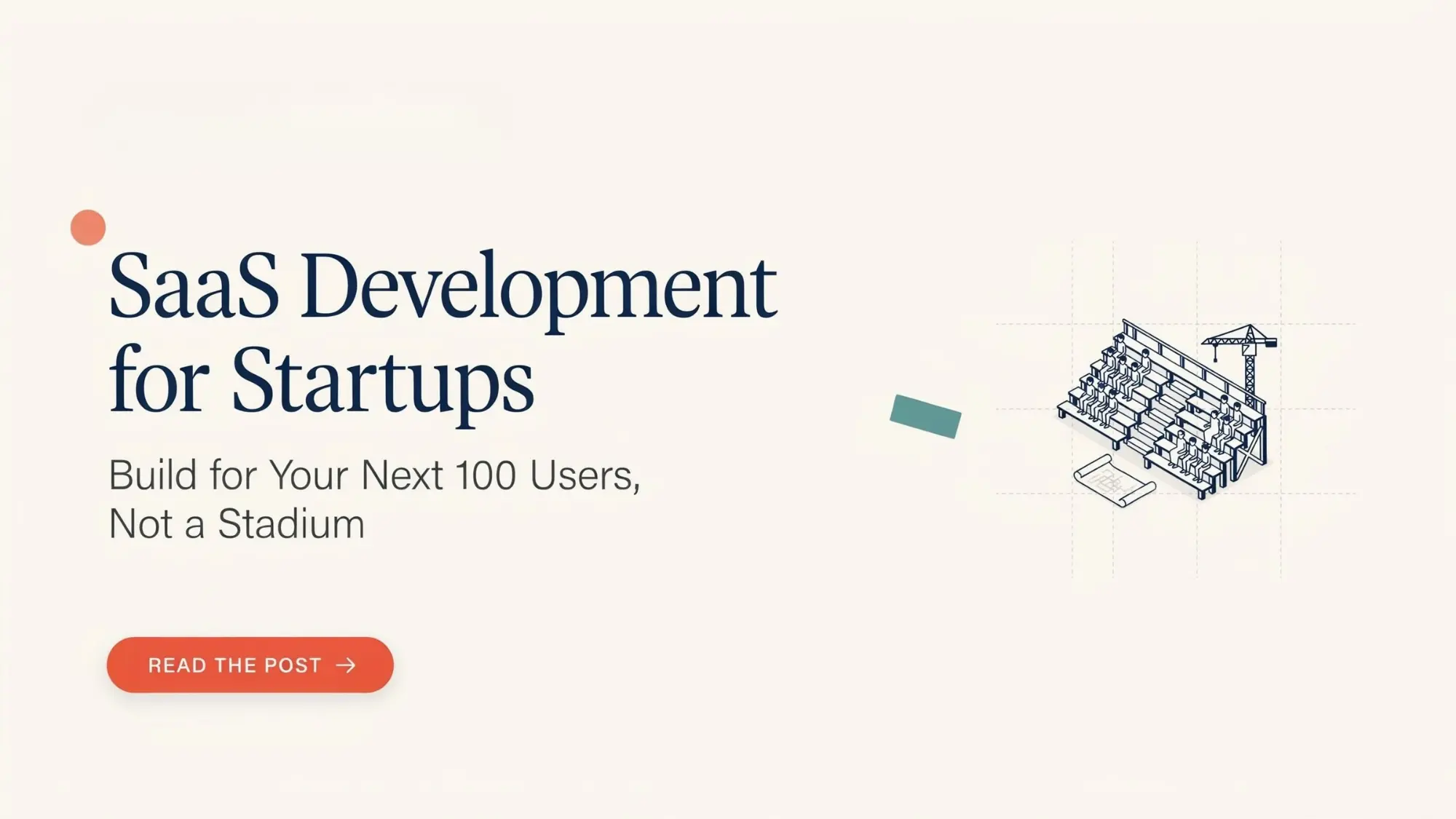
This is the most expensive mistake in SaaS development for startups, and it's committed by smart people for a flattering reason: everyone tells you to "build it scalable." So you build a stadium. For a dinner party.
Must Read: How to Build an MVP for a Healthtech Startup
Version one has exactly one job
It's not to scale. It's to learn — specifically, to find out whether enough people want the thing to make scale a problem you're lucky enough to have.
At eleven customers, your risk is not the servers. Your risk is that customer twelve doesn't exist. Every dollar spent on infrastructure for imaginary load is a dollar not spent testing the only question that matters.
Scale is a good problem. Buy it when you have it.
What a first SaaS version actually needs
Strip away the conference-talk architecture and version one is four things:
- One core workflow, done properly. The single thing users pay for, built well — not five things built adequately. The products that win pick one.
- A boring, proven stack. Boring is cheaper to build, easier to hire for, and fixable at 2 AM. The exciting stack is a tax you pay monthly in surprises.
- Simple billing and simple permissions. Subscriptions and an admin/user split. The fourteen-role enterprise permission matrix can wait for the enterprise.
- A way to see what users actually do. Because version one's whole job is learning, and you can't learn from a product you can't observe.
The most underrated tool in early SaaS: a human
Here's the secret nobody puts on their landing page: with twenty customers, your "automation" can be a person.
Onboarding "flow"? A founder doing it on a call. The "billing system"? An invoice. The "AI-powered matching engine"? For the first few months, it can literally be Priya with a spreadsheet, and your customers will never know or care — they care that the thing works.
Manual behind the curtain isn't cheating. It's the cheapest possible way to learn what's worth automating, before you spend real money automating the wrong thing.
What earns its way in later
None of this is "never." It's "not until someone's blocked without it":
- SSO and enterprise permissions — when the first enterprise deal asks.
- Multi-region infrastructure — when latency or an actual outage costs you something.
- The second platform, the integrations marketplace, the white-label option — when real customers, with real money, are asking.
Each of these added on demand costs a fraction of what it costs added on faith. And here's the reassuring part: keeping the door open to scale is an architecture discipline, not a spending level. Clean structure, sensible boundaries, nothing exotic — a good senior engineer builds small in a way that can grow, which is very different from building big in advance. (It's also one more argument for who owns your build mattering more than the hourly rate.)
The four decisions that set your budget
If you remember nothing else, remember that most of a SaaS budget is set by four early choices: one workflow or five; boring stack or exciting one; manual ops or automate-everything; simple billing or enterprise-grade from day one.
Choose small on all four and you'll have money left over for the actual gamble — finding out if the market wants what you made.
Sitting on a SaaS idea and an architecture diagram that's maybe a little too heroic? Show us what you're planning and we'll give you the honest version of what v1 needs — and what can wait for the meteor. No pitch.
Must Read: Fixed-Price vs Hourly Software Development: Who Pays for Surprises?
Blogs:
Explore all blog