

Telehealth looks simple from the outside. A video call, a way to book it, done. Founders who've actually built one know the video is the easy part.
Telehealth app development is really the work of tying together five or six systems, scheduling, patient records, video, payments, notifications, and wrapping the whole thing in compliance tight enough to handle protected health data. Each of those is its own small project. This guide walks through what a telehealth app actually needs, what drives the cost, and how to scope it so it doesn't balloon.
Must Read: How to Choose a Healthcare Software Development Company
What a telehealth app actually needs
Start with the features patients and clinicians can see, then the ones founders forget:
- Booking and scheduling. Not just a calendar. Provider availability, time zones, reminders, cancellations, rescheduling. It's deceptively deep, and it's where a lot of the build hours quietly go.
- Video visits. The part everyone pictures. Usually built on a HIPAA-eligible video service rather than from scratch, so the cost sits in the integration and the "what happens when the connection drops" handling, not the video itself.
- Patient records. Somewhere to store history, notes, and documents, securely, and often shared with a system the provider already uses.
- Payments. Copays and self-pay at a minimum, sometimes insurance eligibility checks. Money plus health data is two compliance problems stacked on each other.
- Notifications. Appointment reminders, follow-ups, results. The unglamorous feature that quietly drives whether anyone comes back.
Then the ones founders almost always leave out of the first plan:
- The clinician side. Providers need their own view: their schedule, a patient queue, a place to write notes. Founders scope the patient app in detail and forget the people delivering the care have to use it too.
- Consent and intake. Forms, e-signatures, and screening questions before a visit. Boring, required, and easy to underestimate.
The compliance layer you can't skip
Nearly every feature above touches protected health data, which means HIPAA applies to all of it, not just the medical records screen. A booking that stores a reason for the visit is PHI. A reminder that names a condition is PHI. A payment tied to a patient is PHI.
That's why compliance in telehealth isn't a feature you add near the end. It's a property of how the whole thing is built: encryption, access controls, audit logs, and signed agreements with every vendor that touches the data, including your video provider. We cover what that actually involves in how to build a HIPAA-compliant app. The short version: build it in from week one, because retrofitting it later usually means going back through the foundation.
The integrations that drive the cost
Telehealth rarely lives on its own, and every connection to an outside system is its own small project with its own surprises:
- Video. A HIPAA-eligible video API that signs a BAA. Straightforward to start, fiddly to make reliable across devices and bad connections.
- EHR or practice-management systems. The moment your app has to read or write to an existing medical record system, complexity jumps. Standards help, but every system is different in practice.
- Payments. A processor that handles healthcare, plus any insurance eligibility work if you go there.
- Pharmacy or labs. If visits lead to prescriptions or tests, those are further integrations, each with its own rules.
You don't need all of these on day one. Which is exactly the point of the next section.
What telehealth app development actually costs
A focused telehealth MVP, one visit type, video plus scheduling plus payments, compliance built in, generally lands in the ranges we broke down in what it costs to build a healthcare app. A full multi-sided platform with EHR integration, insurance, and multiple provider types runs well above that.
As always, the number is set by scope and integrations more than by anything else. Two telehealth apps with the same budget can look completely different depending on how many outside systems they had to talk to.
How to scope it so it doesn't balloon
The founders who ship telehealth on budget do one thing: they pick a single visit type and build that well first.
One patient type, one kind of visit, the smallest set of features that lets a real appointment happen end to end, book it, attend it, pay for it, follow up. Get that working, put it in front of real users, and let what you learn decide what comes next. Insurance, extra provider types, pharmacy integrations, group visits, they're all real, and they can all wait until the core visit works.
Trying to launch every visit type and every integration at once is the most reliable way to turn a telehealth build into a budget you can't finish.
The short version
Telehealth is scheduling, video, records, payments, and notifications, held together by compliance and a handful of integrations. The video is easy. The scope is the hard part. Start with one visit type, build compliance in from the first line, and add integrations only when a user is blocked without them.
If you're planning a telehealth product and want a straight read on what version one should include and what it would take to build, tell us what you're working on. No pitch.
Must Read: How Much Does It Cost to Build a Healthcare App in 2026?
Blogs:
Explore all blog

HL7 Integration Services: What You're Actually Paying For
A CTO told us his platform was FHIR-native, so HL7 wasn't his problem. Two weeks later the hospital sent over a spec for an ADT feed over MLLP. Here's what HL7 integration work actually involves, and what makes one interface cost three times another.

Clinical Data Integration: Why the Single Patient View Is So Hard to Build
A team demoed a beautiful unified patient dashboard. A nurse in the room asked one question: is this medication list current? Nobody could answer it. That question is the whole problem with clinical data integration.
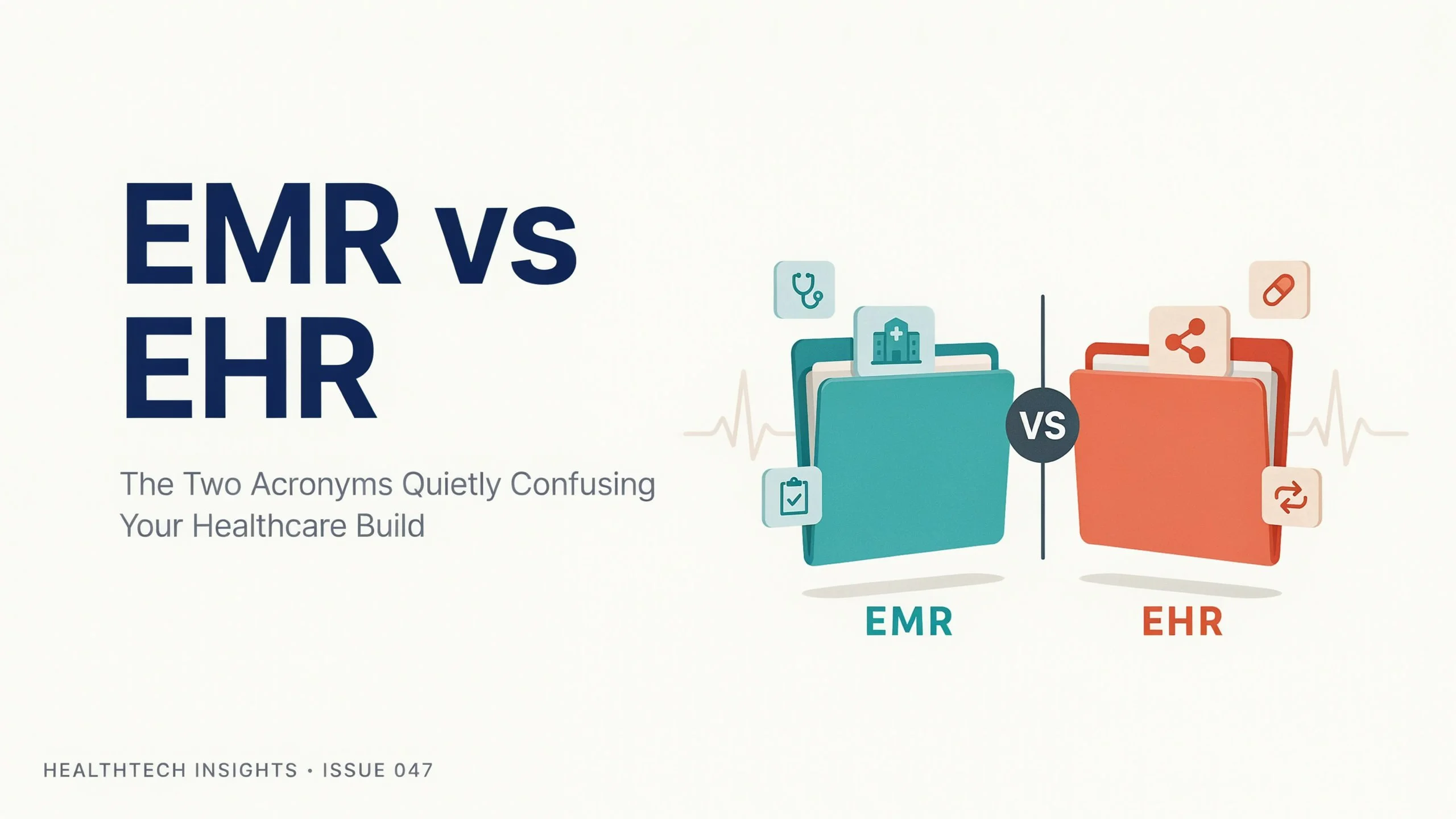
EMR vs EHR: The Two Acronyms Quietly Confusing Your Healthcare Build
A founder once lowered his voice on a call and asked, like he was confessing something: "What's actually the difference between an EMR and an EHR?" Six months into building a healthtech product. Here's the answer, and why it changes your build.