Vibe Coding: How AI Agents Are Shaping the Next Generation of Dev Workflows
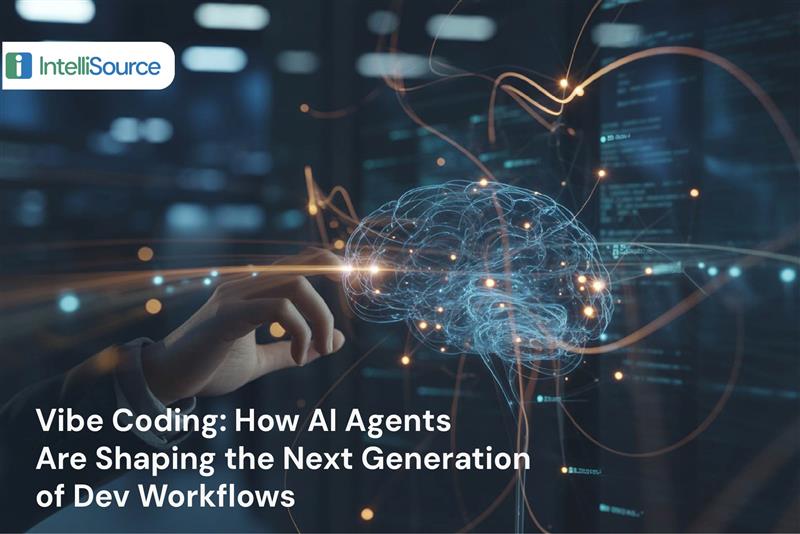
Software development is changing very fast, and automation, collaboration, and intelligence are the building blocks of contemporary processes. The developers have stopped making lines of code but are coordinating systems that are more adaptable, learn, and create in ways unheard of before. The use of AI-driven tools is accelerating this shift by reinventing the coding approach.
In the middle of this transition is an idea that combines creativity, intuition, and automation to vibe coding. It is a fresh paradigm to enable the developers to concentrate less on repetitive processes and more on the creation of innovative solutions.
What Is Vibe Coding?
Imagine vibe coding as a flowing code. Developers no longer have to spend their time reading syntax errors or manually debugging they can engage AI systems that read their mind and make recommendations, such as improving the code or automating development. It is a tradition that puts more emphasis on being creative and innovative in terms of the focus rather than being a grunt.
Research by McKinsey suggests that up to 45 percent of coding tasks could be automated by generative AI, enabling developers to focus on design and logic use cases. That is why developers can now think that those tools can sense them vibing it ever more, letting us see human-AI collaboration soar smoothly.
There is an increasing trend in the demand for coding methods that focus on innovation and efficiency as more companies incorporate AI into their software development services . Vibe coding is not only a fashion, but also a transitional area between old and new ways of working, between the present and the future of programming.
The Role of AI Agents in Development
AI is no longer a support tool, but a working coding partner. This is the way intelligent systems are changing the daily developer work and streamlining and speeding up workflows.
- Smart Code Writing
AI agents for coding can be used to generate boilerplate code, optimize logic, and auto-fix syntax errors, saving hours of developer time and allowing developers to work more on creative problems.
- Faster Bug Fixing
These smart systems detect errors in code, propose correct corrections, avoid repeating bugs, and maintain consistent and quality applications all the way to the end of the development cycle.
- Cooperation Across Teams
AI agents also enhance the communication between remote and in-house teams by automating version control and documentation, ensuring that everyone is on track, organized, and productive throughout the project.
- Personalized Knowledgeable Assistance
AI agents for coding observe the patterns that developers use to code and point out areas of weakness, and give on-the-fly feedback, so anyone is able to keep improving and learning without holding up the workflow.
- Better Testing and Usage
AI automates test processes, models test situations, and handles deployment pipelines. No bugs in releases, and successful software rollouts with minimal human oversight.
Key Benefits of Vibe Coding
The use of AI in development has rewards that are altering whole work procedures. The key benefits that characterize the next-generation developer workflows on a global scale are as follows.
Improved Code Quality and Consistency
AI-assisted code review examines the code of millions of code samples to build the optimal practice and eliminates anomalies that could escape human eyes. These systems offer efficient, exhaustive, and neat standardized code in big undertakings in terms of tidy proposals and computerized repairs.
It minimises the number of bugs and technical debt, which are easier to maintain. As a result, vibe codingagents may be viewed as the spying servants that reinforce the culture of quality and accuracy in the development teams so that the software becomes stable and consistent throughout all release cycles.
Reduced Cognitive Load for Developers
The predicament is that as the frameworks and languages grow increasingly complex, developers may grow weary of the decisions and minds. Vibe coding can take this burden through the use of repetitive workflow management and optimum coding paths proposals.
Developers can also be more creative in their solutions to higher-level problems since they do not need routine activities like refactoring, documentation, and dependency checks, which rely on AI. This mental pressure alleviation will boost productivity and lead to a healthier work-life balance, in addition to retaining the best engineering talent under difficult environments.
Seamless Cross-Team Collaboration
Vibe coding avoids the time-consuming, physical separation of developers, designers, and project managers seen in classic silos; in that, project managers talk only to each other, the developers, and the designers involved. It allows the natural engagement in updates, bug tracking, and code reviews without introducing any miscommunication and version conflict cases throughout artificial intelligence-driven environments.
AI agents can code, giving teams the chance to automate regular coordination tasks- e.g., designating issues or updating documentation, or consolidating branches. This transparency and automation will enhance closer collaboration, reduce the number of delays, and keep everyone concentrated on the shared goals of the project.
Challenges & Risks
Despite the unlimited possibilities, there are certain problems that are linked with vibe coding and should be managed properly. They are the major risks that any organization should not be unaware of.
- Overreliance on AI Agents
The developers must not lose their problem-solving and technical depth instinct. When using automation too intensively, it can reduce our capacity to think critically and we can become overly dependent on AI systems.
- Data Security Concerns
Artificial intelligence operates with massive sensitive data. Without any of that, they can become a victim of violations or unintentional data leakage.
- Ethical and Bias Issues
The accuracy of the AI decisions depends on the quality of their training data. When biased or incomplete data is involved, the coding outcomes are likely to be skewed in both cases or unethical.
- Integration Complexity
It will be necessary to make massive adjustments to the implementation of AI in pipelines. Organizations might experience infrastructural, compatibility, and upskilling problems during the adoption process.
How Vibe Coding Is Reshaping Dev Workflows
Rapidly changing the way developers work, create, and deliver results, vibe coding is changing what developers think and dream of. The most effective methods for innovating everyday development are:
Contextual Code Recommendations
Whenever AI suggests the corresponding code snippets because of its purpose and previous work, it improves working speed and accuracy.
- Dynamic Task Management
The intelligent agents automatically distribute their resources and automate prioritization of tasks based on expertise and urgency of the project with regard to the developers.
- Continuous Learning Feedback Loops
Every interaction builds AI, and it recalls what has been learned in the past project to give intelligent recommendations in the forthcoming ones.
- Enhanced DevOps Integration
Automation of CI/CD contributes to the reduction of downtime and speedy deployment, along with improved cooperation between teams.
- Proactive Bug Prediction
Historical data will be utilized by AI to perform the search for possible vulnerabilities at hand, which will allow developers to stop errors before testing.
- Automatic Documentation Creation
The NLP models create a framing of data that may be read in real-time, avoiding time and increasing project management.
- Predictive Performance Optimization
AI monitors the performance of the runtime and automatically changes the system settings within a real-time span to attain better scalability and the user experience.
Future Outlook
Vibe coding will become the next stage that will provide greater synergy between intelligent systems and developers. With the development of AI capabilities, development will become a mutual creative conversation between human intuition and algorithmic logic.
Gartner estimates that as early as 2027, 80 percent of software projects will be based on AI-driven assistants. This transformation is a worldwide trend of hyper-efficient, intelligence-first development environments.
With the development of next-generation developer workflows, code will be more adaptive, predictive, and emotionally aware, allowing developers to create smarter and more human-centric digital experiences.
The revolution ofvibe coding is an indication of a new age, whereby creativity and computation come together. Those companies that adopt it today will have agility, accuracy, and leadership in the changing digital world.
At Intellisource, we help organizations integrate AI-powered coding solutions that redefine how they build, test, and deploy software. Ready to accelerate your innovation journey? Contact us today to explore how vibe coding can empower your next project.
 Previous blog