
On a call last spring, a founder lowered his voice like he was about to confess something.
"Can I ask a dumb question? What's the actual difference between an EMR and an EHR?"
He'd been building a healthtech product for six months. He'd said both acronyms in investor meetings, confidently, sometimes in the same sentence. Nobody had ever explained them, and by month six it felt too late to ask.
Here's the thing: it's not a dumb question. Making two nearly identical acronyms mean different things is just healthcare's favorite party trick. And the difference genuinely changes what you're building, so let's kill the confusion in five minutes.
Must Read: EHR Integration: What Founders Need to Know Before You Build
The difference, in one kitchen
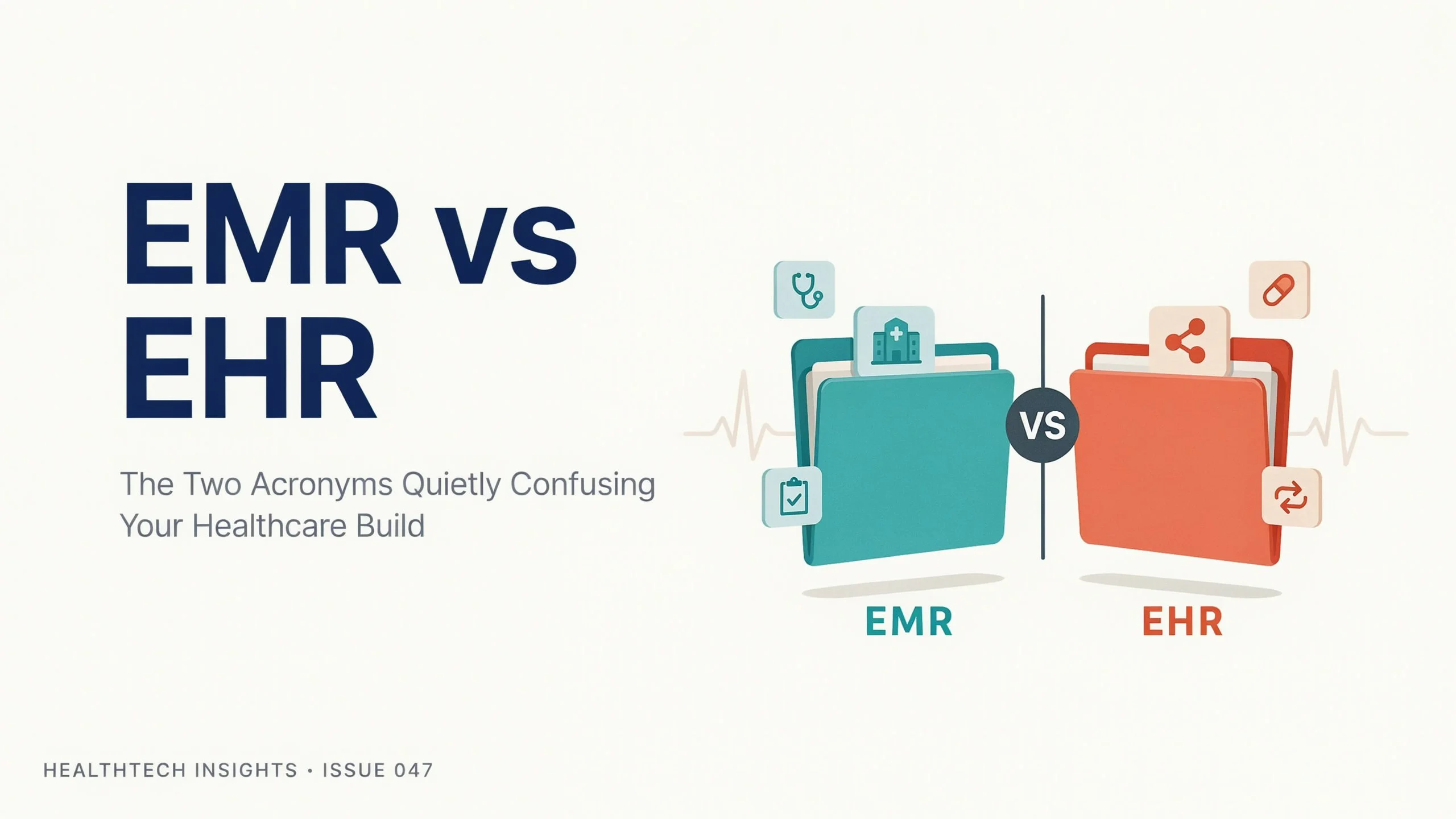
An EMR — electronic medical record — is a digital chart inside one practice. Think of it as the notebook a chef keeps in their own kitchen. Patient history, notes, medications, all of it lives in that clinic, for that clinic.
An EHR — electronic health record — is designed to travel. It's the recipe database every branch of the restaurant shares. The record follows the patient across providers, labs, hospitals, and systems.
Same ingredients. Completely different plumbing.
The industry uses the terms sloppily (even vendors do it), so don't feel bad. But when you're specifying software, the distinction stops being trivia and starts being budget.
Why it matters for your build
Ask yourself one question: does the data in my product need to leave the building?
If your product lives inside one organization — a clinic's internal tool, a single practice's workflow — you're in EMR territory. Simpler world. Fewer handshakes with outside systems.
If information has to move between organizations — your app pulls a patient's history from a hospital, pushes a visit summary back, syncs with labs — you're in EHR territory. And EHR territory comes with the full welcome package: interoperability standards like HL7 and FHIR, vendor developer programs, approval timelines you don't control, and integration work that deserves its own line in the budget. We wrote the unvarnished version of that in our EHR integration guide.
One clarifying thought that helps most founders: you're usually not building an EMR or an EHR. You're building a product that has to talk to one. That's a smaller job than building the record system itself, but only if you scope the conversation properly.
What each answer does to your budget
"EMR territory" builds tend to be more contained. The data model is yours, the walls are yours, and compliance — while never optional — has a smaller surface to cover.
"EHR territory" builds inherit someone else's rules. Every outside system you connect to is its own mini-project with its own quirks, and two platforms that both "support FHIR" can still disagree like two people who both claim to be "flexible about restaurants." The costs land in integration and in waiting — and the waiting is the part founders never budget for. (The full cost picture lives in what it costs to build a healthcare app.)
Three questions that sort it out
Before anyone quotes your build, you should be able to answer:
- Whose data is it, and where does it live today? One practice's system, or scattered across providers?
- Does anything need to move between organizations in version one? Not eventually. Version one. "Eventually" is a phase-two word.
- If yes — which specific system, by name? "We'll integrate with their EHR" without naming it is a guess wearing a suit.
A partner who's built in healthcare will ask you these before you ask them. If the questions land as a surprise on their side, that tells you something too.
The short version
EMR: the record inside one practice. EHR: the record designed to travel. You're probably building neither — you're building something that talks to one, and which one, and whether data crosses organizational walls, quietly sets a chunk of your budget.
And if you've been nodding along in meetings for six months without knowing the difference: you were never the only one. The founder from that call wasn't either.
Building something that has to live in this alphabet soup? Tell us what you're working on and we'll give you a straight read on which territory you're in and what it means. No pitch.
Must Read: How to Choose a Healthcare Software Development Company
Blogs:
Explore all blog
HL7 Integration Services: What You're Actually Paying For
A CTO told us his platform was FHIR-native, so HL7 wasn't his problem. Two weeks later the hospital sent over a spec for an ADT feed over MLLP. Here's what HL7 integration work actually involves, and what makes one interface cost three times another.

Clinical Data Integration: Why the Single Patient View Is So Hard to Build
A team demoed a beautiful unified patient dashboard. A nurse in the room asked one question: is this medication list current? Nobody could answer it. That question is the whole problem with clinical data integration.

Top Healthcare Software Development Companies: How to Pick Yours (2026)
Ten tabs open, ten identical websites, all of them 'leading' and 'innovative.' Here's a shortlist organized by the only thing that matters — which situation you're in — and the questions that separate a fit from an expensive mistake.