
"It just needs to connect to their existing system."
That one sentence has quietly broken more healthcare budgets than any other. EHR integration sounds like plugging in a cable — you connect your app to the hospital's records system and data flows. In practice it's one of the largest and least predictable parts of a healthcare build, and founders almost always underestimate it.
This is the plain-English version of what EHR integration actually involves, why it's harder than it looks, what it does to your cost and timeline, and how to tell whether you even need it in version one.
Must Read: How to Choose a Healthcare Software Development Company
What EHR integration actually means
An EHR — electronic health record — is the system a hospital or clinic uses to store patient data: histories, notes, medications, lab results, appointments. Epic, Cerner (Oracle Health), athenahealth, and others.
"EHR integration" means your app needs to read from, or write to, that system. Pull a patient's history into your app. Push a visit summary back into theirs. Sync appointments both ways.
The reason it matters: if your product touches a provider's existing workflow, it almost always has to talk to their EHR. And that's where a clean-sounding requirement turns into a project of its own.
Why it's harder than it looks
A few things make EHR integration genuinely difficult, and none of them are visible from the outside:
- The standards leave room for interpretation. Health data moves over standards like HL7 and the newer FHIR. They help, but they're guidelines, not guarantees. Two systems can both "support FHIR" and still implement it differently enough to break your integration.
- Every system is different in practice. Connecting to Epic is a different job from connecting to Cerner, which is different again from a smaller clinic's setup. Experience with one doesn't fully transfer to the next.
- Access is gated. You usually can't just connect. There's an approval process — registering with the EHR vendor's developer program, getting credentials, sometimes review and sign-off. That takes time you don't control, and it often has to start early.
- You're working with someone else's system. You can't change how the EHR behaves. You build around its quirks, its downtime, and its limits, not the other way around.
Put together, this is why "it just needs to connect" is never just a connection.
What it does to your cost and timeline
The honest version: a single EHR integration can add weeks to a build and a meaningful chunk to the budget. Two or three integrations, and it can become the largest line item in the project — larger than the app your users actually see.
The timeline risk is worse than the cost risk, because a lot of it is outside your team's hands. Waiting on vendor approvals, credentials, and test environments can stall a project even when the engineering is ready. That's why a good team scopes integration separately and starts the access process early, rather than folding it into a feature estimate and discovering the delay halfway through. We break down how these things move a budget in what it costs to build a healthcare app.
The questions to ask before you commit
You can't evaluate the engineering yourself, so evaluate the answers. Before a partner quotes your build, they should be asking you — and able to answer — these:
- "Which EHR, and which version?" "We'll integrate with their system" without naming it means they're guessing at the cost.
- "Who owns getting access, and how long does that take?" A real answer includes the vendor's developer program and a realistic timeline for approvals.
- "Are we reading, writing, or both?" Writing data back into an EHR is harder and riskier than reading from it. The scope changes the price.
- "What happens when their system is down or changes?" You want a team that plans for the EHR misbehaving, because it will.
- "Can we launch version one without this?" Sometimes the honest answer is yes — which brings us to the last point.
If those questions land as a surprise, the team hasn't done this before.
When you don't actually need it yet
Here's the part that can save you the most money: you may not need the integration in version one at all.
Plenty of healthcare products can launch and prove themselves with data entered directly, or a simple export, and add deep EHR integration later — once there's a real customer whose workflow depends on it. Building a complex, expensive integration before you have a user who needs it is a classic way to spend your whole budget on plumbing nobody's using yet.
The discipline is the same one that governs every healthcare build: start with the one outcome your product has to deliver, and add integrations only when a real user is genuinely blocked without them.
The short version
EHR integration is rarely a simple connection. The standards vary, every system is different, access takes time you don't control, and the cost and timeline impact is easy to underestimate. Name the specific system, scope it as its own project, start the access process early, and be honest about whether you need it in version one.
If you're planning a product that has to talk to an EHR and want a straight read on what that actually involves for your build, tell us what you're working on. No pitch.
Must Read: Telehealth App Development: Features, Costs, and Compliance
Blogs:
Explore all blog
HL7 Integration Services: What You're Actually Paying For
A CTO told us his platform was FHIR-native, so HL7 wasn't his problem. Two weeks later the hospital sent over a spec for an ADT feed over MLLP. Here's what HL7 integration work actually involves, and what makes one interface cost three times another.

Clinical Data Integration: Why the Single Patient View Is So Hard to Build
A team demoed a beautiful unified patient dashboard. A nurse in the room asked one question: is this medication list current? Nobody could answer it. That question is the whole problem with clinical data integration.
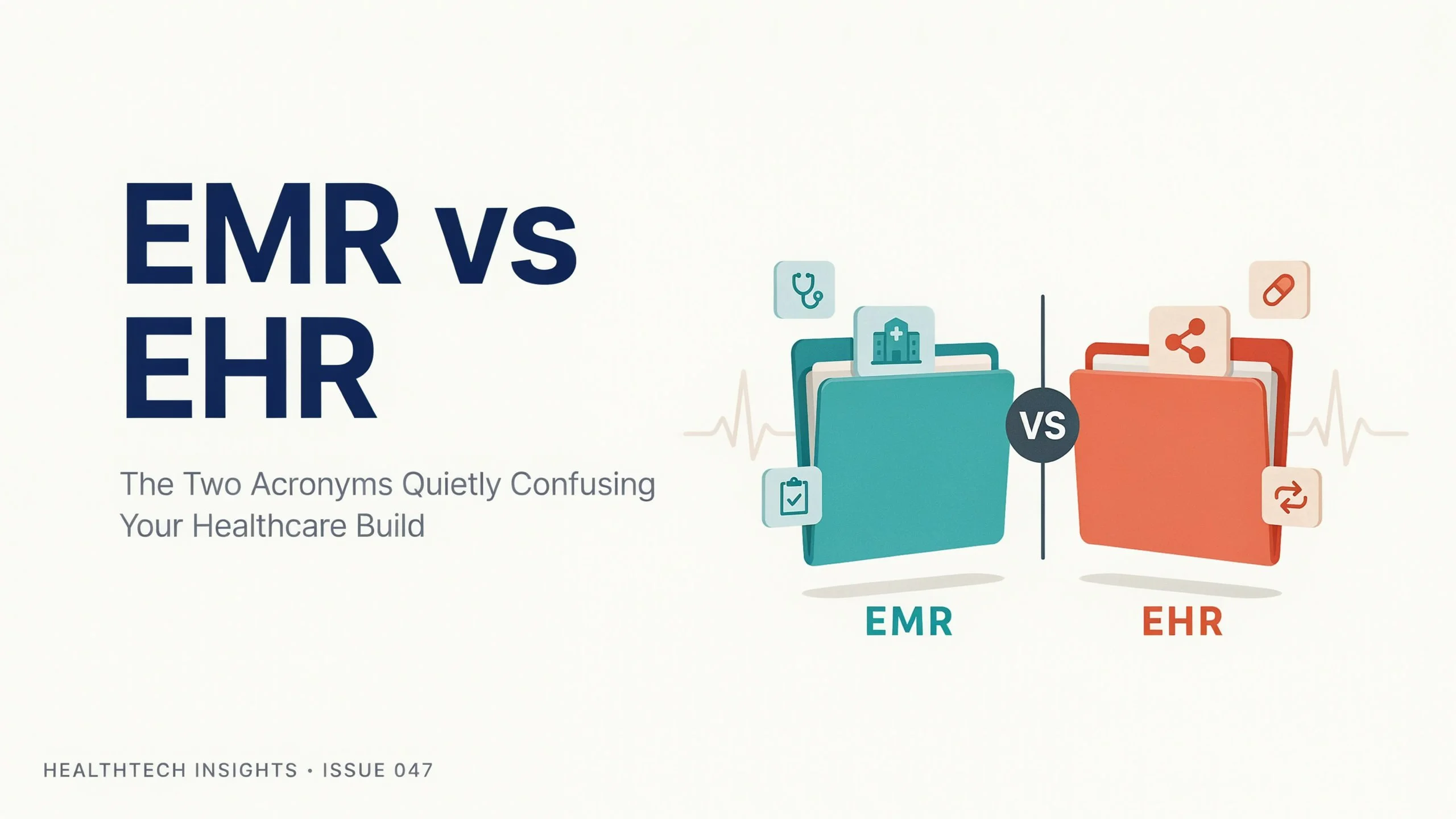
EMR vs EHR: The Two Acronyms Quietly Confusing Your Healthcare Build
A founder once lowered his voice on a call and asked, like he was confessing something: "What's actually the difference between an EMR and an EHR?" Six months into building a healthtech product. Here's the answer, and why it changes your build.