
The honest answer to what it costs to build a healthcare app is a range, and anyone who gives you a single number before asking about your project is guessing. What I can do is show you where the money actually goes, so the range stops feeling like a mystery.
Most of the cost is decided before a single line of code gets written. It's set by scope and compliance, not by how fast anyone types.
Must Read: How to Choose a Healthcare Software Development Company
The rough ranges
For a focused first version, a healthcare MVP with a handful of core features on one platform usually lands somewhere around $30K to $70K. A fuller product with integrations, an admin side, and two platforms tends to run higher, often $70K and up. These are directional. Your number depends on the things below.
What actually drives the cost
- Compliance. Handling protected health data properly takes real engineering: encryption, access controls, audit logging, and signed agreements with any vendor that touches the data. It's not optional and it's not free, but it's far cheaper to build in from the start than to bolt on after a scare.
- Integrations. The moment your app needs to talk to an existing system, like an EHR, a lab, or a payments provider, cost goes up. Each integration is its own small project with its own surprises.
- Platforms. Web only is cheaper than web plus iOS plus Android. Every platform you add is more to build and more to test.
- Feature depth. "A scheduling feature" can mean a simple calendar, or a system with reminders, cancellations, provider availability, and time zones. The words are the same. The cost isn't.
- Who builds it. A team with a senior owning the architecture costs more per hour and less over the life of the product, because you're not paying twice to fix early mistakes.
The costs founders forget
The build quote isn't the whole bill. Budget for the things around it: hosting and infrastructure, third-party services, app store fees, and ongoing maintenance once you're live. Software isn't a one-time purchase. A reasonable rule is to expect ongoing costs after launch for fixes, updates, and small additions.
How to keep it under control
The single biggest lever is scope discipline. Build the one outcome your product has to deliver, get it in front of real users, and let what you learn fund the rest. Founders who try to launch with everything tend to spend the most and learn the least.
A fixed-scope contract with a written change process protects you here. It turns "can we also add..." into a calm, costed decision instead of a budget leak. If you want the full method, our pillar guide on choosing a healthcare software development company covers how to scope and vet before you commit.
So, what will yours cost?
Genuinely, it depends on the five drivers above. If you tell us what you're trying to build and who it's for, we'll give you a real range instead of a sales number. Start there.
Must Read: How to Build a HIPAA-Compliant App
Blogs:
Explore all blog
HL7 Integration Services: What You're Actually Paying For
A CTO told us his platform was FHIR-native, so HL7 wasn't his problem. Two weeks later the hospital sent over a spec for an ADT feed over MLLP. Here's what HL7 integration work actually involves, and what makes one interface cost three times another.

Clinical Data Integration: Why the Single Patient View Is So Hard to Build
A team demoed a beautiful unified patient dashboard. A nurse in the room asked one question: is this medication list current? Nobody could answer it. That question is the whole problem with clinical data integration.
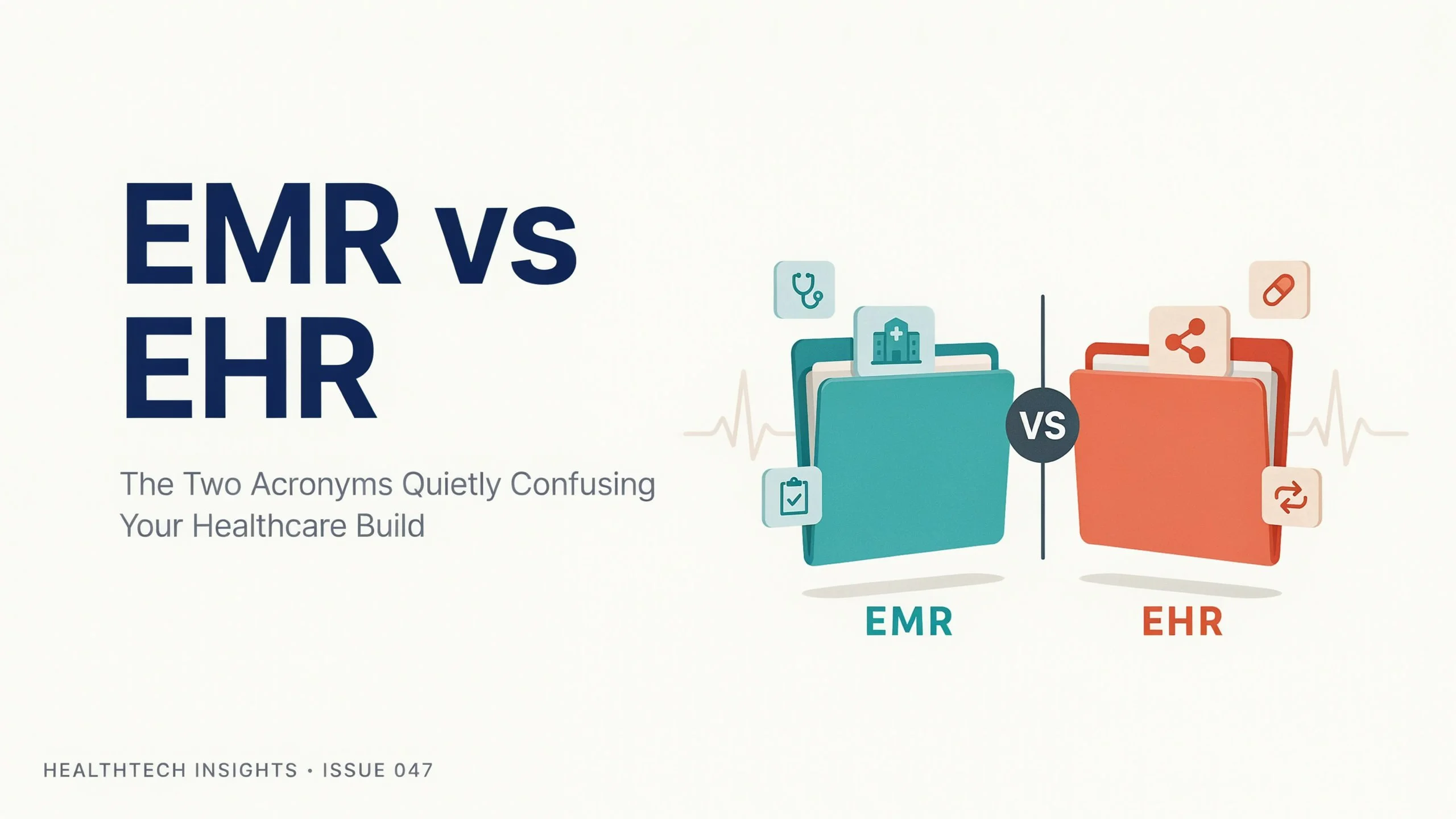
EMR vs EHR: The Two Acronyms Quietly Confusing Your Healthcare Build
A founder once lowered his voice on a call and asked, like he was confessing something: "What's actually the difference between an EMR and an EHR?" Six months into building a healthtech product. Here's the answer, and why it changes your build.