
If your app touches US health information, HIPAA isn't optional, and getting it wrong is expensive. The good news for non-technical founders: you don't need to become a compliance expert. You need to understand enough to ask the right questions and recognize a partner who knows what they're doing.
A quick caveat before we start. This is a plain-English overview, not legal advice. HIPAA is a law, and for anything specific you should talk to a qualified compliance professional. With that said, here's the working knowledge.
Must Read: How to Choose a Healthcare Software Development Company
What HIPAA is actually about
Strip away the jargon and HIPAA protects one thing: a person's health information. The law calls it PHI, protected health information. That's anything that ties a person to their health, like a name next to a diagnosis, an appointment, a medical record number.
If your app creates, stores, or moves PHI, the rules apply. And they apply not just to you but to anyone you hand that data to, which is where a lot of founders get caught out.
What it requires, in practice
HIPAA breaks into a few areas, but for an app the parts you'll feel most are technical:
- Encryption. PHI has to be protected both when it's stored and when it's moving across the internet. This is standard for a competent team and a glaring gap if it's missing.
- Access control. Not everyone should see everything. The system needs to limit who can access what, and verify people are who they say they are.
- Audit logs. You need a record of who accessed which data and when. If something goes wrong, "we don't know who saw it" is not an acceptable answer.
- Business Associate Agreements. Any third-party service that touches PHI, your hosting, your analytics, your messaging, has to sign a BAA agreeing to handle it properly. No BAA, no PHI through that service. This one trips up founders constantly, because plenty of popular tools won't sign one.
The mistakes that cost people
A few patterns show up again and again:
- Using a third-party tool that never signed a BAA, so PHI leaks through the back door.
- Logging PHI somewhere it shouldn't be, like plain error logs.
- Treating compliance as a final checklist instead of an architecture decision, then discovering at the end that the foundation has to be rebuilt.
- Assuming "the cloud is secure" means "we're compliant." It doesn't.
What to ask whoever builds your app
You can't audit the code yourself, so audit the answers. Ask how they encrypt data at rest and in transit. Ask how access is controlled and logged. Ask which third-party services will touch PHI and whether each one will sign a BAA. Ask whether they've shipped a compliant product before, and to walk you through how.
If the answers are specific and a little boring, that's a good sign. Compliance done right is boring. If the answers are hand-wavy, keep looking.
Build it in, don't bolt it on
The cheapest time to get HIPAA right is at the start, in the architecture. The most expensive time is after launch, after a problem. That's the whole point. A partner who understands healthcare bakes this in from week one, which is exactly what we mean in our guide to choosing a healthcare software development company. It also affects your budget, which we cover in what it costs to build a healthcare app.
If you're building something that handles health data and want to know whether your plan holds up, tell us about it and we'll give you an honest read.
Must Read: How Much Does It Cost to Build a Healthcare App in 2026?
Blogs:
Explore all blog

HL7 Integration Services: What You're Actually Paying For
A CTO told us his platform was FHIR-native, so HL7 wasn't his problem. Two weeks later the hospital sent over a spec for an ADT feed over MLLP. Here's what HL7 integration work actually involves, and what makes one interface cost three times another.

Clinical Data Integration: Why the Single Patient View Is So Hard to Build
A team demoed a beautiful unified patient dashboard. A nurse in the room asked one question: is this medication list current? Nobody could answer it. That question is the whole problem with clinical data integration.
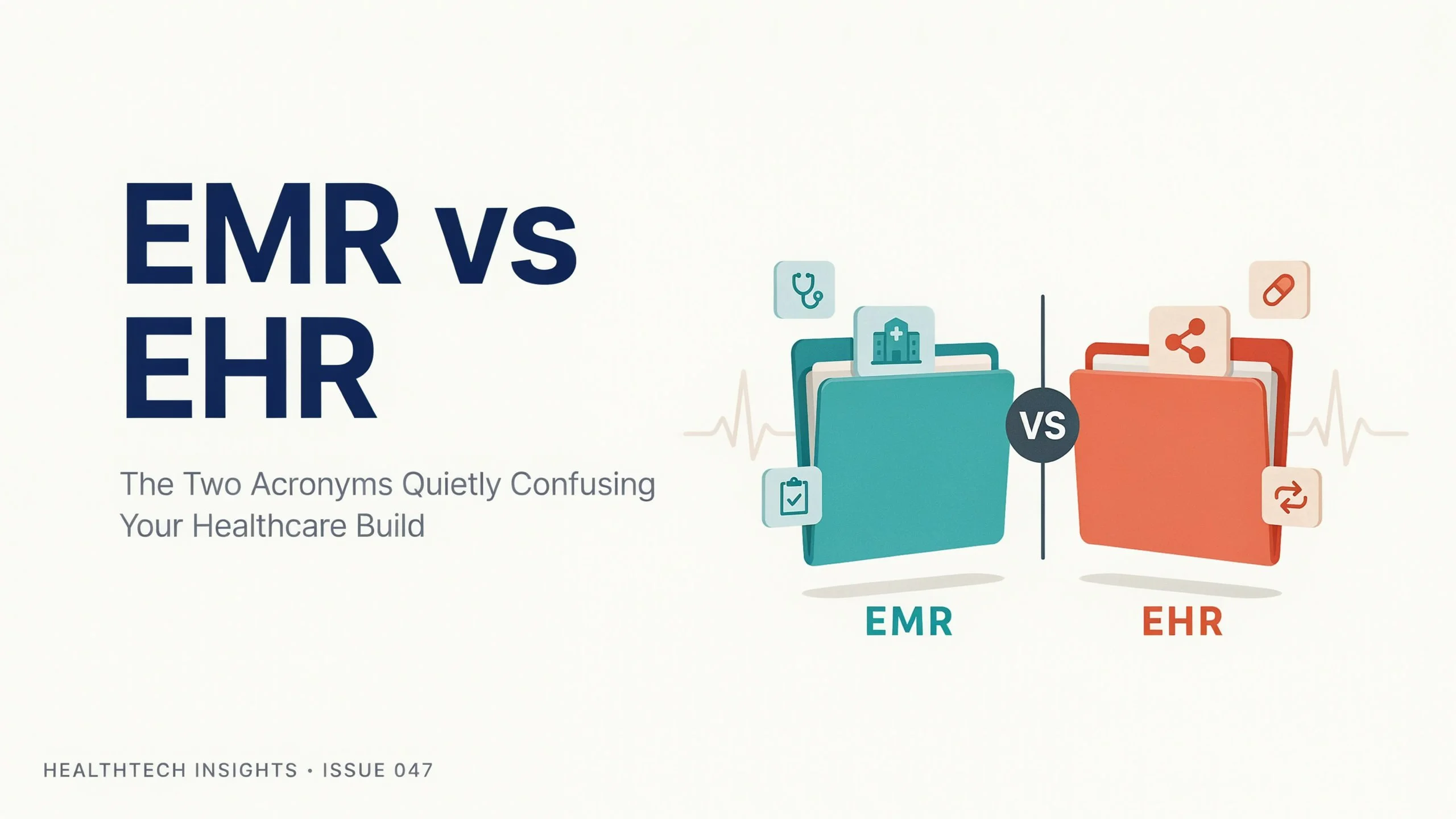
EMR vs EHR: The Two Acronyms Quietly Confusing Your Healthcare Build
A founder once lowered his voice on a call and asked, like he was confessing something: "What's actually the difference between an EMR and an EHR?" Six months into building a healthtech product. Here's the answer, and why it changes your build.