
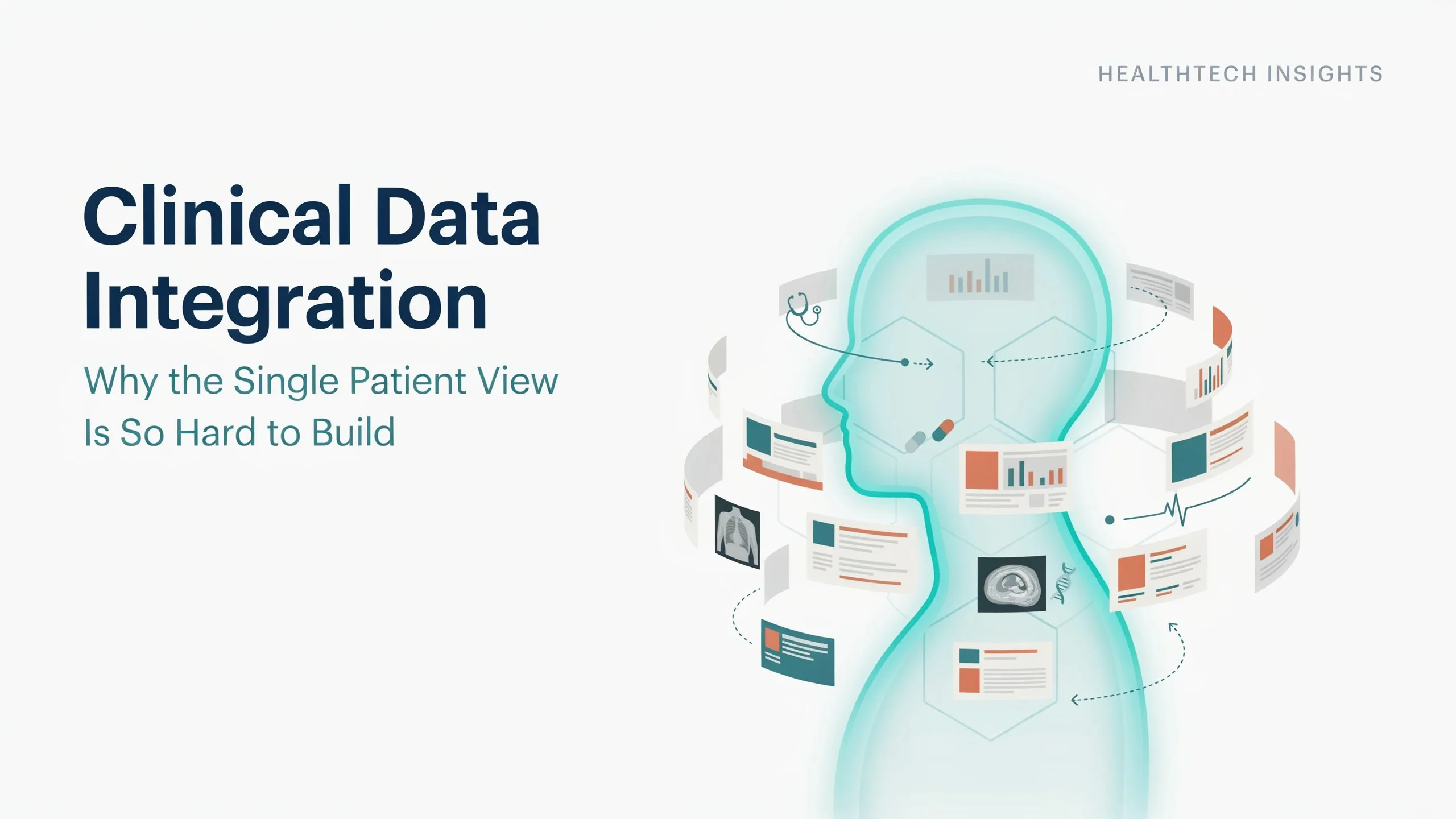
The demo looked great. One screen, one patient, everything in a single view. Labs, medications, diagnoses, recent visits, all pulled together from four different systems. The team had worked on it for months and they were rightly proud of it.
Then a nurse in the room asked one question.
"Is this medication list current?"
Silence. Not because nobody had thought about it, but because the honest answer was "some of it, probably, depending on which system it came from and when that system last sent us anything."
That question is the entire discipline of clinical data integration compressed into five words. Getting the data onto one screen is the easy part. Making a clinician willing to act on what's on that screen is the actual job.
Must Read: EMR vs EHR: The Two Acronyms Quietly Confusing Your Healthcare Build
What clinical data integration actually means
The definition is boring: combining patient data from multiple clinical sources into a single usable view. EHRs, lab systems, imaging, pharmacy, devices, sometimes claims data.
Most teams hear that and picture an ETL job. Pull from several APIs, normalize, write to a database, render.
That mental model survives about two weeks of contact with real healthcare data, and it fails for four specific reasons. Each one is solvable. None of them is solved by the thing most teams reach for first.
Problem one: you don't know who the patient is
Everyone has merged two contact lists before. The same person shows up as "Mike," "Michael J." and a bare phone number, and you sit there squinting at three entries trying to work out whether they're one human.
Now do that with a hospital, a lab, a pharmacy, and an imaging center, where each one assigned its own internal ID and none of them share.
The United States has no national patient identifier. HIPAA called for one back in 1996, and Congress blocked funding for it two years later. The block has been renewed ever since, so matching happens on demographics instead: name, date of birth, address, sometimes the last four of a social security number.
Which means every clinical integration runs into the same wall. Sarah Chen at the hospital, S. Chen at the lab with a typo in the birth year, and Sarah Chen-Martinez at the pharmacy after she got married. Same person. Three records. No shared key.
The tool for this is an EMPI, an enterprise master patient index, which scores demographic fields to decide whether records belong to the same person. Deterministic matching wants exact agreement. Probabilistic matching assigns weights and returns a confidence score, which is usually what you end up needing.
And here's the part that makes this a product decision rather than an engineering one. Match too loosely and you show one patient another patient's allergies. Match too tightly and you hide a real record from the clinician who needed it. Both are patient safety events. Somebody on your team has to own where that threshold sits, and it should not be whoever is closest to the code that day.
Problem two: everyone speaks a different dialect
Two systems can both send you a blood glucose result. One calls it "Glucose, serum." The other sends a local code your team has never seen. A third sends the LOINC code, which is the one that was designed for exactly this.
Healthcare has standard vocabularies for this, and you will meet most of them:
| What you're coding | The standard | | --- | --- | | Lab tests and observations | LOINC | | Diagnoses | ICD-10-CM | | Procedures | CPT, HCPCS | | Medications | RxNorm, NDC | | Clinical concepts broadly | SNOMED CT |
The catch is that sites map to these inconsistently. Some code everything properly. Some use local codes with a mapping table maintained by one person who left in 2021. Some do both, inconsistently, in the same feed.
So a real chunk of clinical data integration work is terminology mapping, and it's ongoing rather than one-time. New test codes appear. Formularies change. Your mapping tables need an owner, the same way a database needs a DBA.
Problem three: fresh and stale look identical
Back to the nurse's question.
A medication list from a live feed updated ten minutes ago and a medication list from a document snapshot pulled in 2023 render exactly the same way on screen. Same fields, same layout, same confident typography. Nothing in the data itself announces which one you're looking at.
Clinicians make decisions from this. If your interface can't distinguish current from historical, you've built something that looks authoritative and isn't, which is worse than building something that looks incomplete.
The fix is unglamorous: capture the timestamp of the source event and the timestamp of your last successful sync, then show both. Then decide what your screen does when a feed has been silent for six hours. Grey the section out, show a banner, something. Doing nothing is a decision too, just a worse one.
Problem four: where did this come from
Provenance is the question of which system said what, and when.
Clinicians care because a result from the hospital's own lab carries different weight than an outside record of unknown origin. Your engineers care because when a value looks wrong, they need to trace it back through the mapping to the original message. And your compliance people will care eventually, since you're now holding clinical data you didn't generate and someone will ask you to explain where it came from.
Teams routinely skip this to hit a demo date, then rebuild it under pressure eight months later when a clinician reports a wrong value and nobody can reconstruct where it came from.
Why "we support FHIR" doesn't finish the job
FHIR is genuinely good. It gives you consistent resource structures, a sane REST API, and something far more pleasant to work with than pipe-delimited HL7 v2 messages.
What it doesn't do is tell you that the Sarah Chen in this response is the same human as the S. Chen in that one. It doesn't reconcile local lab codes. It doesn't tell you whether a resource reflects this morning or a three-year-old document import.
FHIR standardizes the envelope. The four problems above all live inside the envelope, and they're still yours.
This is where a lot of project timelines quietly break. The integration gets scoped as API work, the API work goes fine, and then the team discovers that most of the remaining effort is identity, terminology, freshness, and lineage. Our EHR integration guide covers the access side of this in more detail.
Decide these before you build
Which sources feed version one, and which are phase two? Every additional source multiplies matching and mapping work rather than adding to it.
Who owns the patient matching threshold, by name? This is a clinical safety call, not a config value.
What does the interface do with stale data? Answer it in design, not in a hotfix.
Do you need a full longitudinal record, or the last known value? These are very different systems, and most products need the second one while asking for the first.
Who maintains the terminology mappings in year two? If the answer is nobody, the answer is you, eventually, in a hurry.
The short version
Clinical data integration fails on four things, and none of them are the API: knowing the patient is the same patient, knowing the codes mean the same thing, knowing whether the data is current, and knowing where it came from.
FHIR helps with the transport and structure. It leaves all four of those to you. Budget accordingly, decide the matching threshold with a clinician in the room, and put timestamps on the screen where people can see them.
The nurse's question is the one to design against. If a clinician can't tell how current the data is, the prettiest dashboard in healthcare is still something they'll quietly stop trusting.
Building something that has to pull clinical data from more than one place? Tell us what you're working on and we'll give you a straight read on what the integration actually involves. No pitch.
Must Read: EHR Integration: What Founders Need to Know Before You Build
Blogs:
Explore all blog
HL7 Integration Services: What You're Actually Paying For
A CTO told us his platform was FHIR-native, so HL7 wasn't his problem. Two weeks later the hospital sent over a spec for an ADT feed over MLLP. Here's what HL7 integration work actually involves, and what makes one interface cost three times another.
EMR vs EHR: The Two Acronyms Quietly Confusing Your Healthcare Build
A founder once lowered his voice on a call and asked, like he was confessing something: "What's actually the difference between an EMR and an EHR?" Six months into building a healthtech product. Here's the answer, and why it changes your build.
Top Healthcare Software Development Companies: How to Pick Yours (2026)
Ten tabs open, ten identical websites, all of them 'leading' and 'innovative.' Here's a shortlist organized by the only thing that matters — which situation you're in — and the questions that separate a fit from an expensive mistake.