
You have ten tabs open. Every one of them says "leading." Every one says "innovative." Six use the same stock photo of a doctor smiling at a tablet.
This is the part of choosing a healthcare software development company that nobody warns you about: the websites are useless for telling them apart. They all list the same services, claim the same expertise, and describe the same process in the same words. So founders end up choosing on price, or on whoever answered the phone first — which is how the eighteen-month rebuild story starts.
Here's a different approach. Instead of ranking companies against each other, this guide organizes them by the situation you're in — because the best healthcare software development company for a two-person startup is almost never the right one for a hospital system, and vice versa.
Fair disclosure before we go further: we're one of the companies on this list. We've said where we fit and, more usefully, where we don't.
Must Read: How to Choose a Healthcare Software Development Company
First, find your situation
Almost everyone commissioning healthcare software falls into one of four buckets. Find yours, and eight of your ten tabs close themselves.
You're a founder with an idea and no technical team. You need someone who will scope honestly, build a first version, and tell you what to leave out. Your risk is overbuilding.
You're a growing healthcare business with a product that's straining. You have something real — a portal, an app, an internal tool — and it's creaking. Your risk is a rebuild you didn't need.
You're a provider organization buying or building operationally. Practice tools, patient portals, integrations with what you already run. Your risk is software your staff quietly refuses to use.
You're an enterprise or device company with a regulatory burden. Multi-year programs, formal QMS, sometimes FDA in the picture. Your risk is a partner who's never worked under that scrutiny.
Now the companies, by bucket.
If you're a founder without a technical team
IntelliSource Technologies — that's us, so weigh accordingly. US-based in Florida, healthcare-focused, built specifically for this bucket: a named senior engineer owns your build from first call to launch, scope and price are fixed in writing, and you own all the code. We're a fit when you need HIPAA-compliant products — telehealth, patient portals, EHR-connected apps, MVPs — without hiring an engineering team. We're the wrong call if you need a 500-person program or a managed-services army; two of the firms further down are better at that than we'll ever be.
Arkenea — healthcare only, no other verticals, over a decade of it. If you want a boutique partner who never has to context-switch out of healthcare, they're a natural shortlist entry.
Riseapps — mobile-first digital health. If your product lives or dies on the app-store experience, their portfolio leans that way.
Empeek — patient-facing digital health at Eastern European delivery rates. Good option when the budget is tight and the product is consumer-side.
If your existing product is straining
Simform — their model is extending your team with senior engineers rather than taking over the project. Useful when you have some technical leadership and need reinforcement, not a replacement.
Intellectsoft — bigger firm, mature process, healthcare as a core vertical. A reasonable choice when the work has grown beyond what a boutique can absorb.
And an honest note for this bucket: sometimes the answer isn't a new firm at all. If your product was built by a freelancer or on a no-code platform and it's hit a ceiling, that's a specific kind of project — hardening and rebuilding a validated v1 — and it's worth telling whoever you shortlist that this, not a greenfield build, is the job.
If you're a provider organization
J2 Interactive — the interoperability people. Health information exchange, complex clinical data connectivity, deep InterSystems work. When your project's success depends on systems talking to each other, this is their home turf.
Folio3 Digital Health — EHR integration alongside full product builds. Sensible when connecting to Epic, Oracle Health, or similar is the centre of the project rather than a bolt-on.
TATEEDA Global — San Diego–based, custom medical software, boutique attention with a US anchor. A fit when you want your partner in your own time zone and jurisdiction.
If you're an enterprise or device company
ScienceSoft — two decades in healthcare IT, formal certifications, and comfort with regulated and device-adjacent software. When the compliance burden is heavy and the program is long, an established bench matters more than boutique speed.
The five questions that actually sort them
Once you have two or three names, the websites stop mattering and the answers start. Ask every one of them:
"Have you handled protected health data — and how, specifically?" You want the boring answer: encryption at rest and in transit, role-based access, audit logs, BAAs with every vendor in the chain. Delivered flatly, like a checklist. Enthusiasm plus vagueness is the tell.
"Who, by name, owns my build?" A named senior engineer who'll be on your calls — or a paragraph about "our talented team." One of those ends in a rebuild.
"What's fixed in writing?" Scope, price, timeline — pick which, and get it on paper. If nothing is fixed, everything is.
"How do changes get handled?" The healthy answer is unglamorous: written down, priced, approved before it's built. The friendly answer — "sure, we'll squeeze that in" — is how budgets die by a thousand favors.
"What happens to the code if we part ways?" Documented, and yours. Anything else is a rental agreement wearing a partnership costume.
Run those on identical briefs and compare the answers, not the prices. Which brings us to the thing worth knowing about price.
Why the cheapest quote is often the most expensive
When two proposals for the same product differ wildly, the cheap one is usually missing something specific: a senior owner. Junior people build it fast, it works at launch, and then it has to grow — and growth is where architecture decisions come due.
The invoice difference shows up today. The cost difference shows up in year two, when you pay a second firm to rebuild what the first one delivered. Software is one of the few purchases where the cheapest option and the most expensive option are frequently the same product, eighteen months apart.
If budget is your first question — and it usually is, sensibly — the honest ranges are here: How Much Does It Cost to Build a Healthcare App in 2026?
Two things worth checking before you sign
Compliance is architecture, not a feature. If a company talks about "adding HIPAA compliance" near the end of the project, they've told you they haven't built in healthcare before. It goes in from the first line of code — our founder's version of what that involves is in how to build a HIPAA-compliant app.
Integrations get their own budget line. "It just needs to connect to their existing system" is the most expensive sentence in healthcare software. Any partner who quotes an EHR integration without asking which system, which version, and whether you're reading or writing is guessing. The full breakdown: EHR integration, what founders need to know.
The short version
Skip the rankings. Find your bucket — founder, straining product, provider org, or enterprise — shortlist the two or three companies built for that situation, and put all of them through the same five questions on the same brief.
Every company on this page would tell you they're the right choice. For your specific project, most of us are wrong, and the questions above are how you find out which.
If your situation is the first bucket — a founder or growing healthcare business that wants senior-led, fixed-scope, US-based delivery — tell us what you're building. We'll give you a straight read, including whether someone else on this list is the better fit.
Must Read: Healthtech Software Development: A Founder's Guide
Blogs:
Explore all blog
HL7 Integration Services: What You're Actually Paying For
A CTO told us his platform was FHIR-native, so HL7 wasn't his problem. Two weeks later the hospital sent over a spec for an ADT feed over MLLP. Here's what HL7 integration work actually involves, and what makes one interface cost three times another.
Clinical Data Integration: Why the Single Patient View Is So Hard to Build
A team demoed a beautiful unified patient dashboard. A nurse in the room asked one question: is this medication list current? Nobody could answer it. That question is the whole problem with clinical data integration.
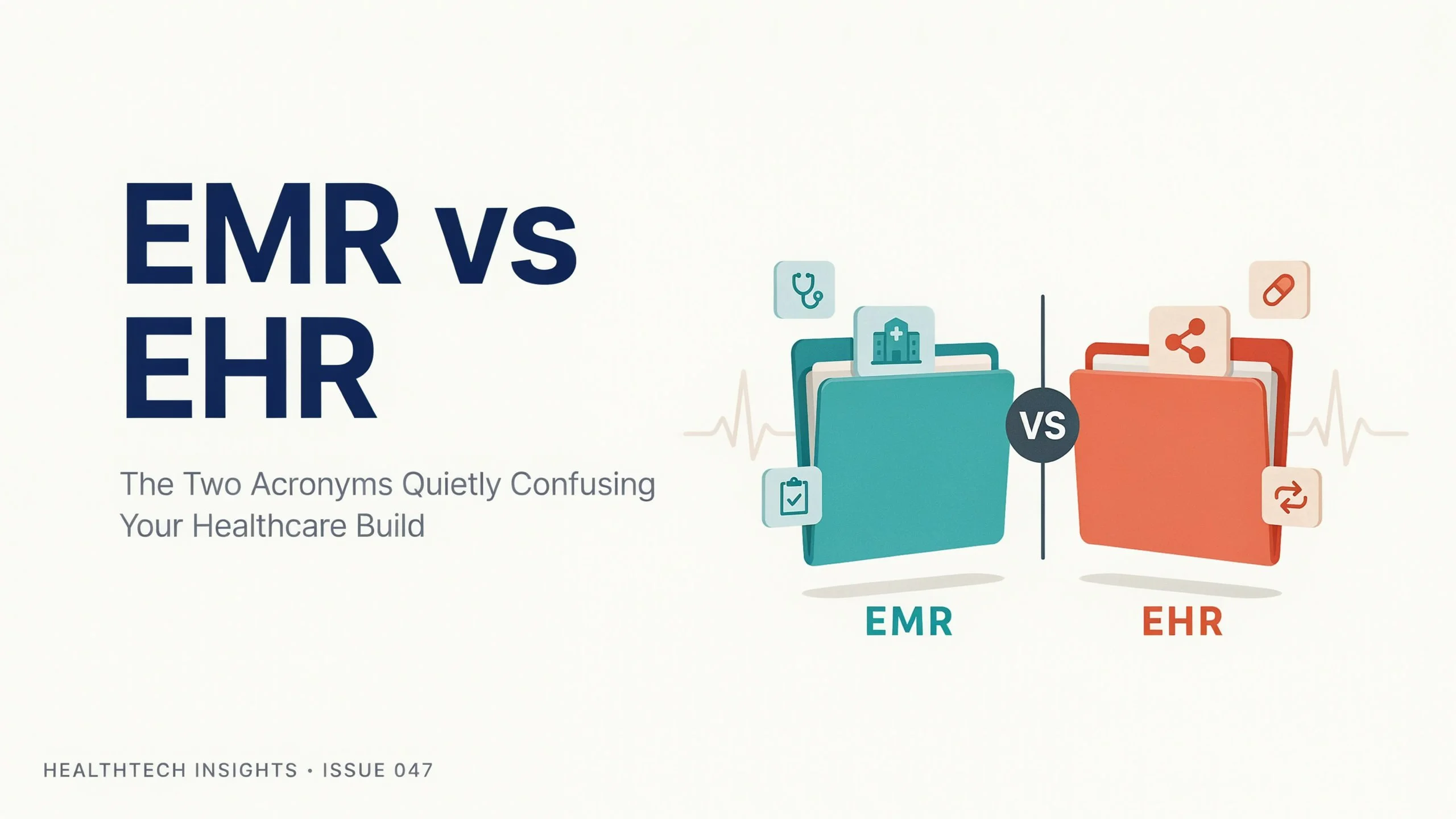
EMR vs EHR: The Two Acronyms Quietly Confusing Your Healthcare Build
A founder once lowered his voice on a call and asked, like he was confessing something: "What's actually the difference between an EMR and an EHR?" Six months into building a healthtech product. Here's the answer, and why it changes your build.