
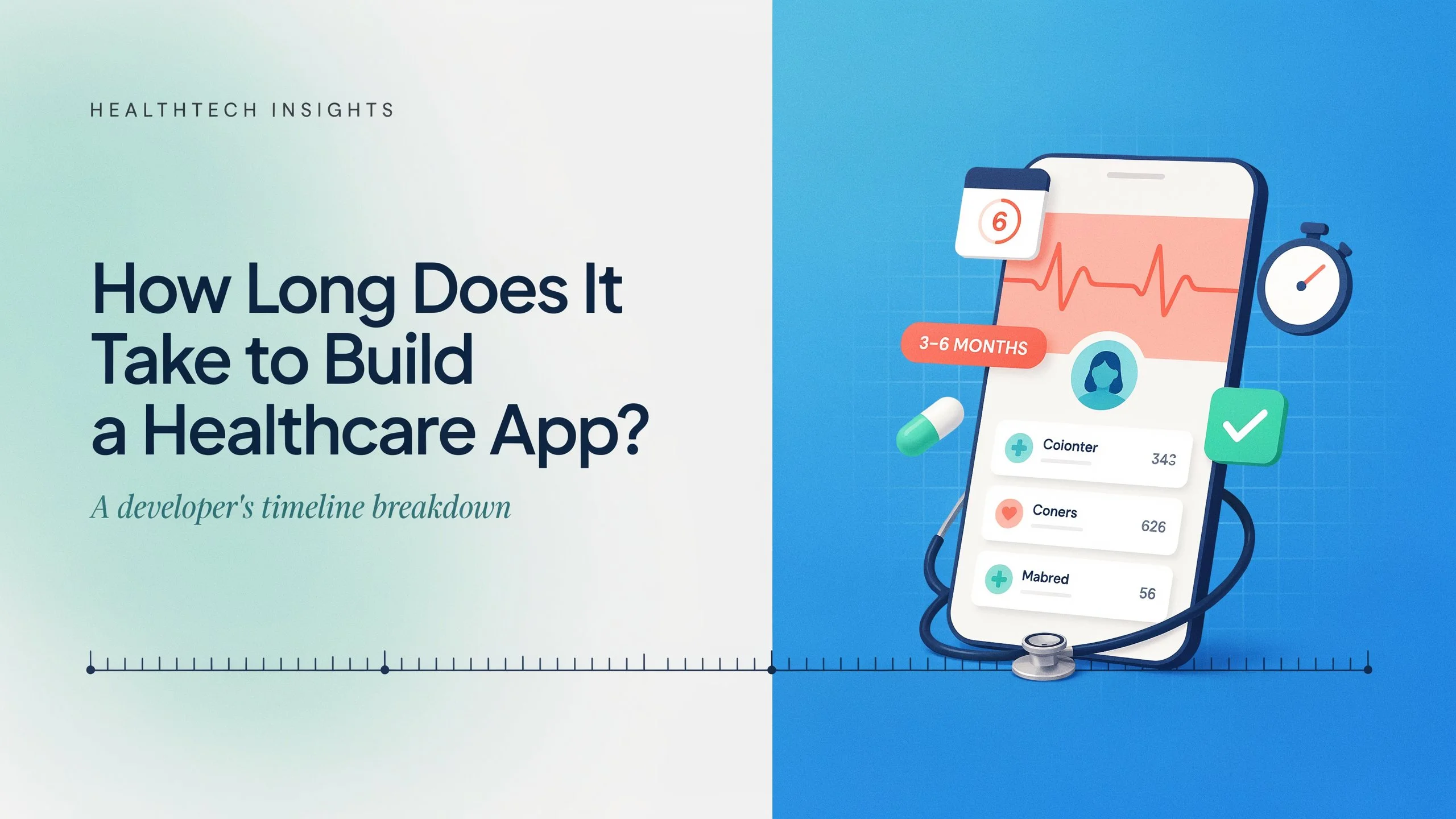
"How long will it take?" is the question every founder asks, right after "what will it cost?" And the honest answer is the same for both: it depends on how disciplined the scope is, not on how fast anyone types.
A focused healthcare app can be live in a few months. A sprawling one can take a year and still feel unfinished. The difference is rarely the engineering team's speed. It's how clearly the product was defined before anyone started. So here's a realistic timeline, and the things that quietly add or remove weeks.
Must Read: How to Choose a Healthcare Software Development Company
A realistic timeline for a healthcare MVP
For a focused first version — one core outcome, one platform, compliance built in — a healthcare MVP usually runs somewhere around 10 to 14 weeks with a team that's done it before. Here's roughly where that time goes:
- Weeks 1–2 — Scope and design. Lock the one outcome the product has to deliver. Wireframes, not a feature list. This is the cheapest place to make changes, and the most expensive place to skip.
- Weeks 3–4 — Foundation. Architecture, sign-in, the data model, and the compliance groundwork. The unglamorous part that decides whether you can scale later.
- Weeks 5–7 — The core feature. The one thing the product must do well gets built and tested first, before anything else is layered on.
- Weeks 8–10 — Supporting features and the admin side. The pieces that make the core usable in the real world, including the view your own team or clinicians need.
- Weeks 11–12 — Hardening. QA, edge cases, a security and compliance pass. Where shortcuts taken earlier come back to bite.
- Weeks 13–14 — Launch and handover. Live, documented, and you understand how it works.
A full, multi-sided platform with integrations and several user types runs well beyond this. The MVP timeline above assumes the discipline to leave those for version two.
What slows a build down
Most delays aren't caused by slow engineering. They're caused by decisions that were never made, or made too late:
- Compliance treated as a final step. Bolting HIPAA on at the end usually means going back through the foundation. Built in from week one, it barely moves the timeline. Added at the end, it can add weeks. We cover what's involved in how to build a HIPAA-compliant app.
- Underestimated integrations. "It just needs to connect to their system" is one sentence that can add a month. Every connection to an EHR, lab, or payments provider is its own small project with its own approvals and surprises.
- Founder indecision. Every unanswered question is a paused task. A build waiting on "let me think about that" isn't moving, no matter how good the team is.
- Scope creep. "Can we also add..." is how a 10-week project becomes a 5-month one. Not because any single addition is large, but because they never stop coming.
What speeds it up
The founders whose builds land on time tend to do the same handful of things:
- Tight scope. One outcome, built well, shipped, then expanded. Narrow is fast.
- A senior who owns it. One experienced engineer accountable for the whole build makes decisions quickly and avoids the rework that eats timelines.
- A fixed process for changes. Changes are fine. Changes with no process are what derail schedules. A written change process turns them into calm, costed decisions instead of surprises.
- Compliance from day one. Building it into the architecture early is the single biggest way to avoid a painful, timeline-wrecking rebuild later.
Faster isn't always cheaper — or better
It's worth saying plainly: rushing a healthcare build is how you end up rebuilding it. A team that skips the hardening phase to hit a date is borrowing time from your future, usually at a bad interest rate. In healthcare, a bug in production isn't just embarrassing — it can be a data problem.
The goal isn't the fastest possible launch. It's the fastest launch you won't regret. Those are different targets, and scope discipline is what closes the gap between them.
The short version
A focused healthcare MVP is realistically a 10-to-14-week build with a team that's done it before. What decides where you land isn't the engineers' speed — it's how tightly the scope is defined, whether compliance is built in from the start, and how quickly decisions get made along the way.
If you're trying to work out a realistic timeline for your specific product, tell us what you're building and we'll give you an honest estimate — including what would make it faster.
Must Read: How Much Does It Cost to Build a Healthcare App in 2026?
Blogs:
Explore all blog
HL7 Integration Services: What You're Actually Paying For
A CTO told us his platform was FHIR-native, so HL7 wasn't his problem. Two weeks later the hospital sent over a spec for an ADT feed over MLLP. Here's what HL7 integration work actually involves, and what makes one interface cost three times another.

Clinical Data Integration: Why the Single Patient View Is So Hard to Build
A team demoed a beautiful unified patient dashboard. A nurse in the room asked one question: is this medication list current? Nobody could answer it. That question is the whole problem with clinical data integration.
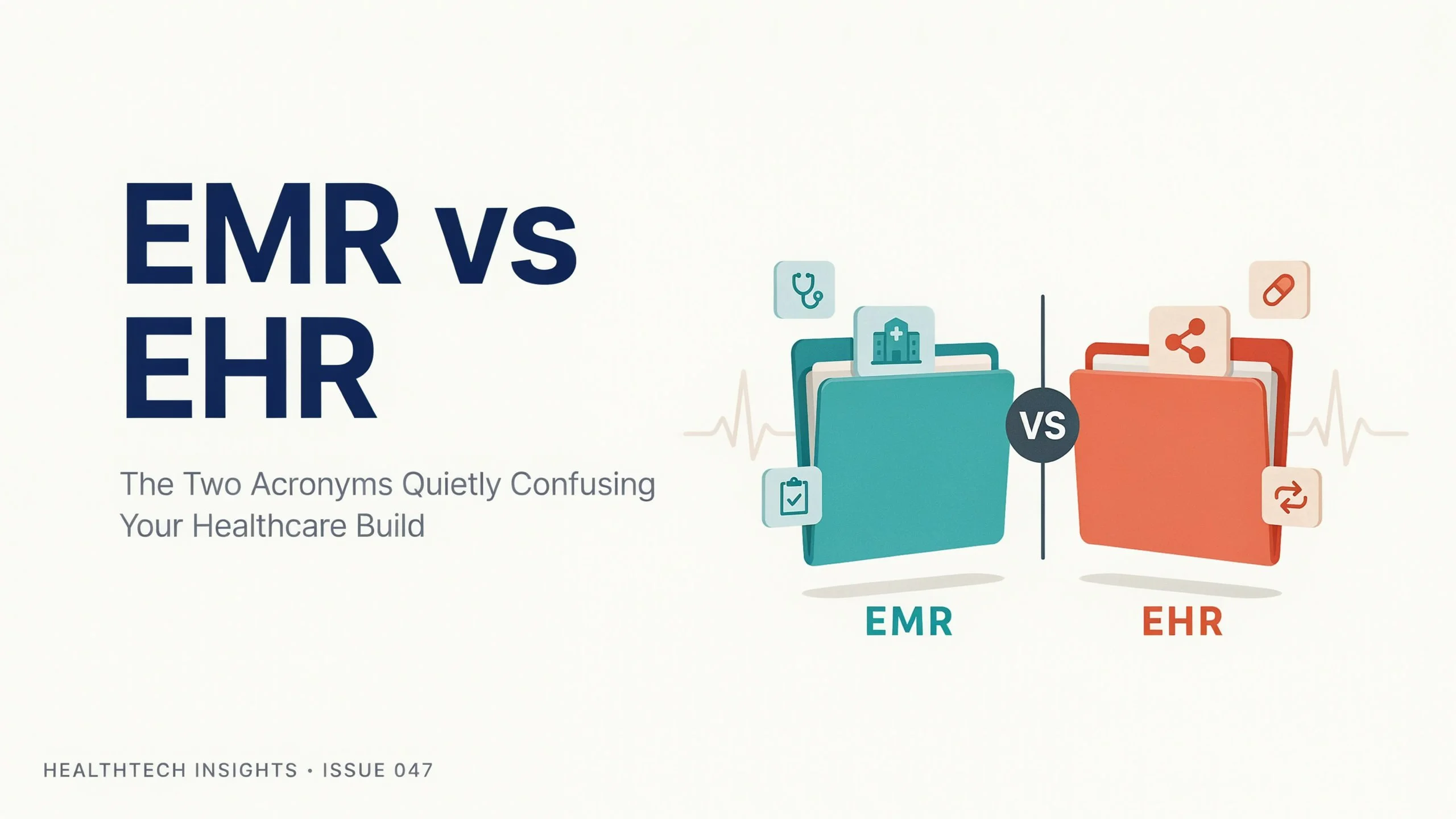
EMR vs EHR: The Two Acronyms Quietly Confusing Your Healthcare Build
A founder once lowered his voice on a call and asked, like he was confessing something: "What's actually the difference between an EMR and an EHR?" Six months into building a healthtech product. Here's the answer, and why it changes your build.